Saturday, September 26, 2015

Friday, September 25, 2015
Introduction to waves


So - Waves.....
We spoke about energy. Energy can, as it turns out, travel in waves. In fact, you can think of a wave as a traveling disturbance, capable of carrying energy.
There are several wave characteristics (applicable to most conventional waves) that are useful to know:
amplitude - the "height" of the wave, from equilibrium (or direction axis of travel) to maximum position above or below
crest - peak (or highest point) of a wave
trough - valley (or lowest point) of a wave
wavelength (l) - the length of a complete wave, measured from crest to crest or trough to trough (or distance between any two points that are in phase - see picture 2 above). Measured in meters (or any units of length).
frequency (f) - literally, the number of complete waves per second. The unit is the cycle per second, usually called: hertz (Hz)
wave speed (v) - the rate at which the wave travels. Same as regular speed/velocity, and measured in units of m/s (or any unit of velocity). It can be calculated using a simple expression:

There are 2 primary categories of waves:
Mechanical – these require a medium (e.g., sound, guitar strings, water, etc.)
Electromagnetic – these do NOT require a medium and, in fact, travel fastest where is there is nothing in the way (a vacuum). All e/m waves travel at the same speed in a vacuum (c, the speed of light):
c = 3 x 10^8 m/s
First, the electromagnetic (e/m) waves:
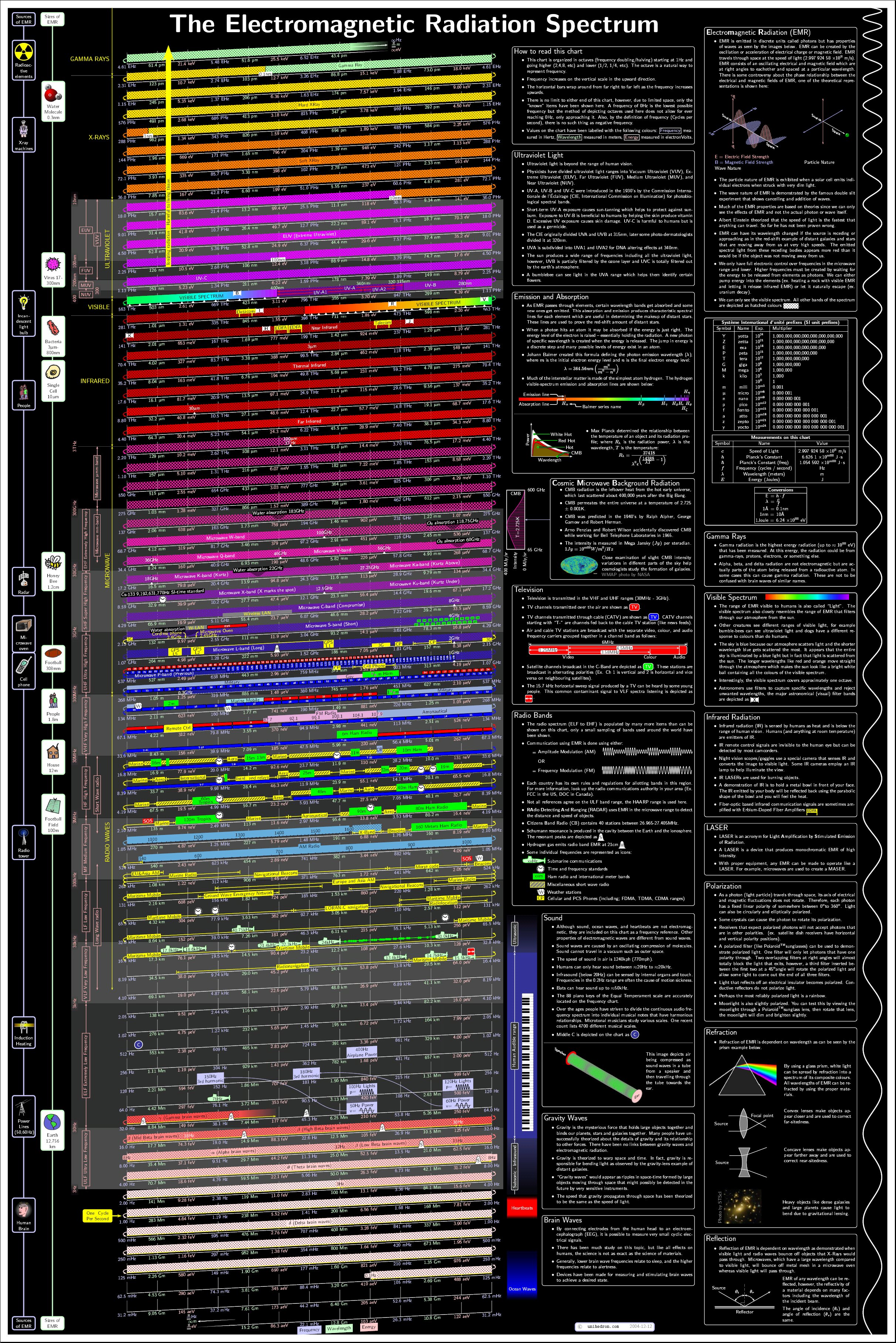
General breakdown of e/m waves from low frequency (and long wavelength) to high frequency (and short wavelength):
Radio
Microwave
IR (infrared)
Visible (ROYGBV)
UV (ultraviolet)
X-rays
Gamma rays
In detail, particularly the last image:
http://www.unihedron.com/projects/spectrum/downloads/full_spectrum.jpg
Mechanical waves include: sound, water, earthquakes, strings (guitar, piano, etc.)....
Mechanical waves include: sound, water, earthquakes, strings (guitar, piano, etc.)....
Again, don't forget that the primary wave variables are related by the expression:
v = f l
speed = frequency x wavelength
For e/m waves, the speed is the speed of light, so the expression becomes:
c = f l
Note that for a given medium (constant speed), as the frequency increases, the wavelength decreases.

Friday, September 18, 2015
HW for Tuesday
For next class:
1. Find an equation that relates wavelength, wave speed and frequency. Use this for the next 2 problems.
2. Calculate the wavelength of a 440-Hz sound wave (which is concert A), if the speed of sound is 340 m/s.
3. The speed of light is approx 3 x 10^8 m/s. What is the frequency of a 0.03-m microwave?
4. Find definitions for mechanical wave and electromagnetic wave.
Wednesday, September 16, 2015
HW for Friday
My apologies for the late addition. I understand if you are not able to complete this.
By Friday, please arrive to class with a definition of "wave" - ideally, a definition that is in your own words, and not a wikipedia quote. Also, draw a basic wave and label or define the following parts:
amplitude
frequency
wavelength
wave speed
Thanks!
By Friday, please arrive to class with a definition of "wave" - ideally, a definition that is in your own words, and not a wikipedia quote. Also, draw a basic wave and label or define the following parts:
amplitude
frequency
wavelength
wave speed
Thanks!
Friday, September 11, 2015
Physics homework for next class (Wednesday)
Pendulum homework - to be turned in next class
1. When we say the “period of the pendulum,” what
exactly do we mean?
2. When we say "simple pendulum", what does that mean? In other words, what does the period of a simple pendulum most depend
on?
3. What is the basic shape of the graph for the
period of a pendulum versus its length?
Please draw this.
4. What is the basic shape of the graph for the
period of a pendulum versus the mass of the bob?
5. Where in the pendulum’s path does it come to a
complete stop?
6. Where in the pendulum’s path does it have
maximum speed?
7. Given what you know about energy, how might you
describe the energy of the pendulum?
8. Find the formula for period of a simple
pendulum.
9. Calculate the period of a 3-m long pendulum.
10. Does the period of a pendulum depend on gravitational acceleration? If so, how?
Wednesday, September 9, 2015
Graphing homework reminder
Today you collected some data for period and length for a pendulum. Ideally, you have at least 10 pairs of data points.
Create a graph, using Logger Pro please. This graph should have length on the x-axis and period for one oscillation on the y-axis. Don't forget units.
If you can, play around with the curve fit and see if you can make a curve fit the data.
If you can't get Logger Pro to download successfully - and some folks have not been able to - download the demo version (but make sure you don't input any credit card data to do so). If you are still not able to make Logger Pro work for you, either use Excel or use a computer at school with Logger Pro.
Finally, if you do not have a computer at home, maybe we can find one for you. Chat with me and I will connect you with our very own organization, Computers for Kids.
Thanks!
Create a graph, using Logger Pro please. This graph should have length on the x-axis and period for one oscillation on the y-axis. Don't forget units.
If you can, play around with the curve fit and see if you can make a curve fit the data.
If you can't get Logger Pro to download successfully - and some folks have not been able to - download the demo version (but make sure you don't input any credit card data to do so). If you are still not able to make Logger Pro work for you, either use Excel or use a computer at school with Logger Pro.
Finally, if you do not have a computer at home, maybe we can find one for you. Chat with me and I will connect you with our very own organization, Computers for Kids.
Thanks!
Friday, September 4, 2015
homework to bring Wednesday (9/9)
Hey everybody!
You've collected some data today. For homework, take a look at the data. What variable(s) seem to affect the time of the pendulum? What affects it a lot? A little? Nothing at all? Can you tell?
Pick the set(s) of data that matter most and graph them. Time (the dependent variable) will be on the vertical (y) axis. Mass, initial height/angle, or length will be on the horizontal (x) axis - these are all independent variables. In general, the independent variable goes on the x-axis and the dependent variable is on the y-axis.
Make one or more graphs and see if any relationship pops out at you.
Either hand-draw the graphs on graph paper or use a computer (Excel or some online graphing program). Bring the print-out of the graph(s) or the handwritten copies to class.
Thanks, and happy weekend!
You've collected some data today. For homework, take a look at the data. What variable(s) seem to affect the time of the pendulum? What affects it a lot? A little? Nothing at all? Can you tell?
Pick the set(s) of data that matter most and graph them. Time (the dependent variable) will be on the vertical (y) axis. Mass, initial height/angle, or length will be on the horizontal (x) axis - these are all independent variables. In general, the independent variable goes on the x-axis and the dependent variable is on the y-axis.
Make one or more graphs and see if any relationship pops out at you.
Either hand-draw the graphs on graph paper or use a computer (Excel or some online graphing program). Bring the print-out of the graph(s) or the handwritten copies to class.
Thanks, and happy weekend!
Thursday, September 3, 2015
Notes on notes.
Some
thoughts on how to take notes in physics. This is all personal
preference, but it has served me well.
1. Use a bound
notebook, ideally with quad-paper. Spiral-bound notebooks fall apart and
binders are cumbersome (and the pages fall out before long). Bound
notebooks keep you "honest."
2. Use a new page
for each new class and/or topic.
3. Write on only
side of the page - it makes it easier to read, particularly if you use pen
(which can bleed through to the other side).
4. Give each new
page a heading and date.
5. Use color to
highlight central concepts and/or put boxes around important ideas or
equations.
6. Draw pictures
that represent the problem - label relevant things in the diagram.
7. Don't use a
laptop to take notes. You spend too much time getting down trivial
details and will inevitably miss something critical. It is also way too
tedious to include equations, pictures, graphs, calculations and anything that
really demands visual representation. The evidence is also pretty clear
on this - taking notes on a laptop is not as helpful (toward understanding or
remembering) as taking notes by hand.
8. Keep a running
page of the important equations or ideas - maybe on the inside cover of the
notebook. Label formulas.
9. If things are moving too quickly for you,
leave space for omitted notes – with a heading of what that topic is. And then touch base with me or a classmate to
fill in the gaps.
10. Leave space in your notes – don’t cram them
all together. Again, writing on one side
of the page is helpful.
11. If you have questions, but don’t want to ask
them in class (or see that we have moved beyond that topic already and you don’t
want to revisit it at the moment) – write down the questions in the margin of
your notes, and circle it. And then seek
out the answer during a break, after class, or by email. But get your question answered!
12. If taking notes on a laptop is really
important for your learning, take images of the board and incorporate them into
your notes. Some students like OneNote or
EverNote for note-taking, but other programs exist and may be worth
considering.
13. By and large, if it is on the board it should
probably be written down. For me personally
- if I think it is important for the students, I will write it on the board.
14. Never be shy about asking for extra help –
even to have me look at your notes.
Sometimes I can tell where you went wrong in your thinking by seeing
errors in your notes.
15. I AM ON YOUR SIDE.
Tuesday, September 1, 2015
Welcome to Physics!
Please watch this video. I'm not sure exactly why I like it so much, but I do. Richard Feynman (1918 - 1988) was an American physicist - probably the most famous one of the 20th century. I often like how he thinks about thinking.
https://www.youtube.com/watch?v=3D2RaDVkylY
And also this, because it is just so cool:
https://www.youtube.com/watch?v=oSCX78-8-q0
Lastly, please take this survey for the science department:
https://www.surveymonkey.com/r/2015summerscience
https://www.youtube.com/watch?v=3D2RaDVkylY
And also this, because it is just so cool:
https://www.youtube.com/watch?v=oSCX78-8-q0
Lastly, please take this survey for the science department:
https://www.surveymonkey.com/r/2015summerscience
Subscribe to:
Comments (Atom)